User Tools

Site Tools


wiki:liath

This is an old revision of the document!


Liath

[nation]


Pronunciation: (LEE-ath)
Continent: Inis
Land Area: 1,377,000 square miles
Length: 1,550 miles north to south
Width: 1,100 miles east to west
Coordinates: 37° N to 26° S, 90° E to 155° E


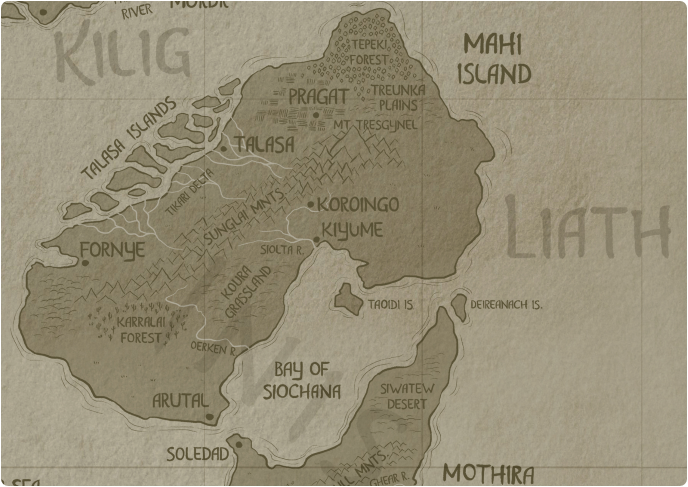
Country comprised of both islands on Inis, this mysterious and isolated land is often sought by adventurers and travellers in search of answers or peace


Cities

  • Arutal - Primate city, Inis' capitol and sister city to Soledad
  • Fornye - Perched on a beautiful bay in northwest Inis
  • Kiyume - Trade hub for goods from Koroingo and Pragat
  • Koroingo - Mining town in the mountains of the northern isle
  • Pragat - The bread basket of Inis
  • Soledad - Sister city to Arutal, though much smaller
  • Talasa - Located on the marshlands of the northern coastline


History

Liath formed late in terra's Iron Age when refugees landed on Inis, fleeing the war between Akkaus and Khan'laheeri. At the time, the kingdom was called Aru'taal, and the nation flourished, remaining neutral through the much of the Blood Wars. Even when Akkaus officially declared war on Aru'taal, it maintained a defensive posture. Eventually the country joined the Aimsir Alliance, though only officially

When the Blood Wars ended with the Council of Ceilidh, Aru'taal became Arutal and gained a reputation for possessing a healing quality. Many terran's would make pilgrimages to Arutal in order to find themselves or to cure their ailments

In the First Age of Balance, Arutal sent people back to the Korahan Coast to rebuild their original homeland, efforts which would lead to the establish the nation of Koraha. The two nations continue to share a strong bond

Timeline

  • 39.2M BCE: Refugees flee the fighting and arrive on the isle of Inis, form the kingdom of Aru'taal
  • 19.8M BCE: Aru'taal builds the Sole'tal bridge
  • 8.4M BCE: Akkaus declares war on Aru'taal
  • 3.8M BCE: Aru'taal joins the Aimsir Alliance
  • 2.0M BCE: Council of Ceilidh, Aru'taal becomes Arutal
  • 1.871M BCE: Arutal sends colonists to return to Koraha and rebuild Kohanga
  • 1.602M BCE: Arutal sends colonists to establish Pragat
  • 1.581M BCE: Arutal is formally renamed Liath
  • 1.316M BCE: Liath colonizes the marshes in Talasa


Government and laws

Cities in Liath are led by Guides, a life long post which roughly resembles a mayor. The Guide has some direct authority, though it is minor. Guides draft legislation and changes to legislation, which are voted on by the citizens of that city. All proposed changes requires two thirds of the vote. When a Guide dies, a series of elections takes place, until a new Guide is chosen, which requires four fifths of the vote

When a vote is held, all members of the city need to cast a vote in order for it to be valid. Exceptions to this rule are very rare. Due to this law, votes are only held once or twice a year

At the national level, the Council of Five votes on legislation proposed by its members or by a Guide. Laws or changes to laws at the national level require four out of five votes, or in some cases, a unanimous vote. Members of the Council cannot be Guides or have ever been Guides, though they must have completed an apprenticeship with a Guide. These apprenticeships can last several years, typically no less than five years. Council appointments are for ten years, after which members cannot serve again. Elections are held once every two years, and two thirds of the national vote is required to gain an appointment. Voting for the national council is different from typical voting and from elections for Guides. Voters are presented with a list of applicants, and they vote for or against each applicant

Laws in Liath are exhaustive when it comes to violence, against humans but also against animals. Harming humans and animals is a serious offense. Additionally, the government does not have the right to harm its citizens. Detaining citizens can only be done on a temporary basis. As a result, punishments for serious crimes often involves exile


Society and culture

Religion
The prevalent religion of Liath is Ahle'ala, which dictates all aspects of daily life within the country. Laws are often informed by its tenets. Some believe that all laws within Liath are simply the evolving interpretations of the tenets of Ahle'ala. The philosophy of Ahle'ala centers around the Five Pillars

  • The Pillar of Energy - Using one's strength and one's ki in a balanced, unified, and good way
  • The Pillar of Mind - Having a proper awareness and knowledge of, and view of, your environment
  • The Pillar of Will - Having proper desires and intentions
  • The Pillar of Action - Keeping one's actions pure, doing no harm to sentient beings
  • The Pillar of Speech - Keeping one's speech pure, speaking the truth, avoiding abusive or divisive speech

Values
The citizens believe in peace with all creatures, and a life of happiness and fulfillment. Achieving this is pursued by adherence to the Ahle'ala. Liath is very welcoming of immigrants and refugees, and has become very diverse as a result. Its people are well known for their good nature

Dress and Appearance
Due to the nation's origins and its open policy regarding immigration, the population of Liath is extremely diverse. Skin, hair, and eye color vary wildly, including combinations not found in any other nation

Styles of dress are consistently unvaried, by comparison. Clothing is exclusively white or lighter greys. The foundation is a vest or short sleeved tunic that extends past the knee and as far as down to the ankle. The tunics are typically close fitting. When needed, a high cropped coat is worn over the vest to cover the arms. Footwear typically consists of sandals made from cloth or wood, or simple cloth bindings. Simple jewelry of wood or stone is common, and is often attached via piercing the skin. Traditional tattoos are ubiquitous and cover large portions of the skin. Hair is shaved on the sides of the head and otherwise worn long in braids, dreads, or left straight

Food
Agriculture and animal husbandry are woven into the fabric of Liath's culture and society. Vegetables an fruits from around the world thrive in Liath's inviting climate. Smaller scale farms and personal gardens are a staple of Liath's landscape, while larger scale agriculture exists in the Treunka plains, centered around the city of Pragat. The Koura grasslands has less agriculture but is home to many shepards. Raising animals for their eggs, honey, and milk is a critical part of Liath's food supply, and much of it is exported, a rare phenomenon.

Rice based dishes with a vegetable medley is a staple meal in Liath. Wines and ciders are produced in many varieties and are a prized export. Meat and products made from animals are illegal to produce in Liath, though not illegal to import, possess, or eat. Very few restaurants will serve these products, and all of them are located in Arutal

Music and Arts
Music is an important part of life in Liath, accompanying celebrations and meditation rituals. Violin and cello are the foundation of musical composition, which includes long, arching melodies designed to soothe the mind and the soul. Bells, drums, and a wide assortment of eclectic instruments are peppered into to performances. The citation of Mantras and throat singing are commonly featured. Dance is also widely enjoyed in Liath, and includes sweeping, graceful movements


Fauna

Flora

wiki/liath.1461353126.txt.gz · Last modified: 2016/04/22 15:25 by caleymccready