Table of Contents
Combat
[rules]
When adventurers get into combat situations or any situation in which time needs to be strictly controlled, the GM initiates combat and special rules govern how the player characters can act
The combat round
A Combat Round is the unit of measurement that combat or other time sensitive events are broken into. Each round represents 6 seconds of game world time. Each round is divided into three segments, representing two seconds of game time each. In each segment, the players can initiate actions which may carry over into following segments
After each round is resolved, if there are still creatures engaged in combat, start a new round. Continue until all combatants are unable to fight or have willingly ceased fighting
A round of combat consists of three segments, which are resolved in order of initiative, as follows:
- Each player and NPC takes their turn, in order of initiative ranking
- On their turn, a player or NPC may initiate a single action (Full, Standard, Move, or Swift)
- One segment of their action plays out, and any ongoing actions they have also play out one segment
- After all players have taken their turn, combat advances to the next segment

Defensive actions
If a creature is targeted with an attack, and the attack would reach the creature before their turn in the initiative order, then the targeted creature has the option to defend themselves provided that they have an unspent action to do so
Initiative
At the start of combat, Initiative is rolled and combatants are ranked in order of their score. This ranking determines the order in which players will initiate actions within a segment of combat. Once initiative ranking is determined, you no longer need to track your actual score. Any subsequent change in initiative moves you up or down one place in the initiative ranking, unless otherwise noted
Determining your initiative score
Roll the number of dice determined by the formula below and count the number of sixes rolled
Dex Modifier + Int Modifier + 4
Breaking a tie in Initiative Score
If two or more combatants get the same number when rolling Initiative, these combatants re-roll their initiative until a winner is determined
Surprise
In the first round of combat, combatants may be slow to react. If a combatant is unaware of their attacker, they cannot act until the second segment of the first round. Similarly, if a combatant rolls no sixes on their initiative roll, they cannot act until the second segment of the round. If a combatant is unaware of their attackers, and also rolls no sixes on their initiative roll, they cannot act until the third segment of the first round. Combatants penalized in this way can still use Reaction
Actions declared before combat
If a player who is not in combat declares an action that prompts initiative, that single action takes place before the first round of combat. If multiple players declare such actions, only the first player's action takes place before the first round of combat
Readied Actions
On your turn in the initiative order, you may declare that you are waiting for conditions to be met before acting. This does not change your rank in the initiative order. This cannot be used to delay actions into subsequent rounds
Unused Actions
If you have a remaining Standard action at the end of your turn, you may spend this action to move up one rank in the initiative order. If you have an unused Full action, or an unused Standard and Move action, you move up two places in the initative order. Alternatively, you may spend a standard action to temporarily be moved to the top of the initiative order for the first segment of the next round. After the end of that segment you return to your normal initiative rank
Action types
 There are different types of actions you may initiate during each combat round.
- Full Action: A Full action requires the majority of your focus in a round to complete. A Full action requires one segment to initiate, but may take effect in following segments
- Standard Action: A Standard action requires an average amount of focus, and only requires one segment to initiate. Most substantial talents require standard actions
- Move Action: A Move action relocates your character on the battlefield. A Move action requires one segment to initiate. For a list of possible Move actions, see below
- Swift Action: A Swift action is a quick action that requires very little of your available focus in a round. A Swift action requires one segment to initiate. If another action allows you to spend a Swift to modify the action, then the Swift action does not require one segment to initiate. You may also use a Swift action to take a 5 foot step
Actions per Round
In each round you have the following possible combinations of actions:
- Full Action
- Standard Action + Move Action
- Move Action + Move Action
In addition to the actions above, you may use up to two Swift actions per round
Reducing a Required Action
Some talent mechanics will allow you to reduce the action required to complete an action by one level. The reduction follows the following sequence:
Full > Standard > Move > Swift > Free
Basic actions
In addition to binding moves, the following actions are available:
Unarmed Strike - Standard
With this attack you strike with a fist or a foot. Speed is 2H, range is 5 feet
Offensive: Attack Bonus + Dex + 2d6
Defensive: Defense Bonus + Dex + 2d6
Damage: Strength + 1d6
Brace - Standard
You prepare for incoming attacks. This action grants you Advantage on any Ability Checks made in the remainder of the round
Reaction - Free
When you do not declare any defense against an incoming attack, you may use a Free action to reduce the impact with the following formula:
Defense Bonus + Int
Other actions
Maneuvers
Speed formulas
When you shoot a blast of fire or other projectile at an opponent it moves at a particular speed. Structures you create may also be manifest at a particular speed. This speed is expressed in the following manner:
Speed: 3H
This signifies that the projectile moves at 3 hexes per segment, or 15 feet. If the target is 30 feet away, then it will take two segments to hit the target
When talking about player movement actions, you may see a speed formula like this:
Speed: 3H+1
This means that you move 3 hexes per segment, but you also have one bonus hex which you may use at some point during the movement action. For more information, see the Movement Actions section

Movement actions
When using a movement action you have the following options:
- Move - As a Move action, you may move your base movement speed over two segements. You may cease your movement at any time, which forfeits all remaining movement
- Dash - As a Move action, you initiate a quick movement over one segment. This movement must be as close to a straight line as possible
- Dodge - As a Move action, you initate a short movement over one segment. This movement imposes disadvantage on one incoming attack of your choice. This benefit may only be utilized in the segment in which you move
- Swim - As a Move action you move your Swim speed over three segments
- Five foot step - As a Swift action, you may move your character one hex
Move and Swim actions can overlap with themselves if more than one is initiated
Movement Action Speeds
Each movement action allows your character to move varying amounts which are determined by your base speed. The table below outlines the speed for each movement action type
| Base Speed | Move (for 2 segments) | Dash (for 1 segment) | Dodge (for 1 segment) |
|---|---|---|---|
| 30 Feet | 3H | 4H | 2H |
| 35 Feet | 3H+1 | 5H | 2H |
| 40 Feet | 4H | 5H | 2H |
| 45 Feet | 4H+1 | 6H | 3H |
| 50 Feet | 5H | 7H | 3H |
| 55 Feet | 5H+1 | 7H | 3H |
| 60 Feet | 6H | 8H | 4H |
| 65 Feet | 6H+1 | 9H | 4H |
| 70 Feet | 7H | 9H | 4H |
| 75 Feet | 7H+1 | 10H | 5H |
| 80 Feet | 8H | 11H | 5H |
| 85 Feet | 8H+1 | 11H | 5H |
| 90 Feet | 9H | 12H | 6H |
Pushback
When an action includes a pushback or reposition, the speed at which the pushback occurs is equal to the speed of the action. The pushback continues in subsequent segments until it is complete. Until the pushback is complete, any of the creature's movement is suspended. Actions that include a pushback must performed at their base speed or faster
Example
You are targeted by an Air Blast with a speed of 5H, which will push you back 30 feet. In the segment that the Air blast makes contact, you are pushed back 5 hexes. In the following segment, you are pushed back 5 feet
Round based penalties
When an action inflicts a penalty that lasts for one or more rounds, the penalties take effect immediately. The duration is counted to the segment level and begins in the segment in which the penalty was inflicted. Actions that occurred in the same round/segment before the penalty are not effected, including movement
Example
You suffer an attack in the second segment of a round. The attack inflicts the staggered condition for one round. Your movement speed is halved for the remainder of the round, and the first segment of the next round. In the second segment of the next round, you may move normally again
Range increments
Whenever a range is given for firing a projectile, the range given is the maximum distance at which you may shoot a target without penalty. Targets that are farther than this incur a -1 penalty for every additional 20 feet they are from the target
Ranges given for non projectile based moves, such as creating a wall, shifting earth, or creating a sphere of flames, are not considered projectiles and this range marks the maximum range at which you are capable of performing the move
Regarding weapons, long ranged weapons have range increments, short ranged weapons do not
Cover
Line of Sight
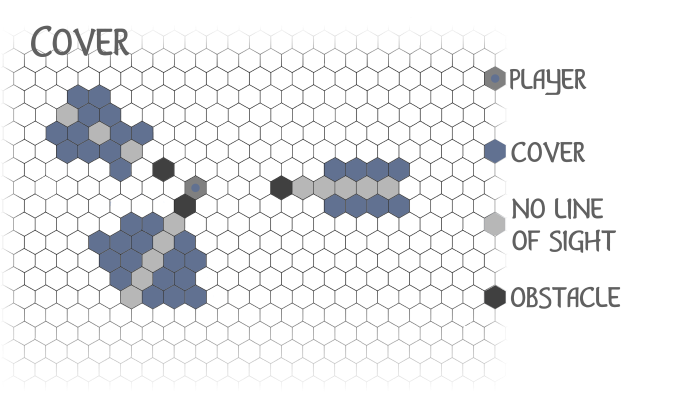
If you cannot draw an uninterrupted line between any point in your hex to any point in your target's hex, you may not target them
Cover
If you cannot draw a uninterrupted line between the center of your hex and the center of your target's hex, your target has cover, imposing disadvantage on your attack. Obstacles adjacent to an attacker do not provide cover to the target
Concealment
While cover addresses physical obstacles, concealment addresses insubstantial cover which blocks visibility. To determine if a target has concealment, Draw a line between any point in your current hex and any point in your target's current hex. If this line passes through a substance that provides concealment, your target gains one level of concealment per hex of substance this line crosses
Levels of Concealment
If your target has partial concealment or concealment, you may still target and attack them, though there is a chance your attack will simply miss the target completely. Roll the chance to miss first, then roll your normal attack. This miss chance is governed by the level of concealment provided by the visual obstacle, see the table below. If, however, your target has total concealment, you may not target them, though you may target the hex you think they occupy.
| Number of hexes between opponents | Concealment Level | Miss chance |
|---|---|---|
| 1 | Partial Concealment | 1/6 |
| 2 | Concealment | 2/6 |
| 3 | Total Concealment | 3/6 |
Stealth checks targeting creatures from whom you have any level of concealment are made at advantage
If a creature stands in a hex of complete darkness, it provides total concealment
Advantage
A game mechanic may grant your character an advantage when performing an action. Additionally, your GM may decide that the circumstances lend you an edge for a specific course of action. Alternatively, the GM may decide that circumstances impose a disadvantage on a related action, or a talent may infer disadvantage on a specific action
- When performing a dice roll at advantage, add 3d6 to the number of dice rolled. When rolling at disadvantage, subtract 3d6 from the number of dice rolled
If there are multiple circumstances where some would lend an advantage and others would lend a disadvantage, they cancel out completely. If two creatures would have advantage against each other in a contested roll, they both roll at advantage
Note: Advantage can never be applied to hit-point rolls
Leverage
An advantage represents something that gives you an edge in a situation, but it may not be directly related to your opponent. When racing someone through the snow, having snowshoes would be an advantage. In some situations, you have the ability to pivot the conditions of the situation itself with minimal effort. When you can move a very heavy rock with a lever, you have leverage. When you can dictate the terms of a debate because you hold a political office, you have leverage
- When performing a dice roll with leverage, add 6d6 to the number of dice rolled
- Leverage does not stack with Advantage, it supersedes it
- Leverage does not cancel out disadvantage
- If two creatures would have leverage against each other, they both roll with leverage
- Leverage cannot be used to remove dice from a roll
Cooldowns
Many talents have cooldowns, which prevent you from using them in quick succession. Cooldowns are expressed in rounds, representing the number of rounds before you can use that talent again. The cooldown begins counting in the round after you use the talent
Example
You use Blade in the second round of combat. Your blade has a cooldown of 1 round. In the fourth round, you are free to use Blade again
Exhaustion
If a character attempts to use bindings over a longer period of time, they will begin to tire. This applies in situations such as using aeromancy to fill the sails of a ship, or using petramancy to move rocks out of a quarry
After one hour of continuous binding, the creature must make a Strength Check in order to continue. The DC for this check is 10. Every hour the DC increases by 2 and the check must be made again. Reset the DC after a full night's rest
A failed check also incurs the Exhausted condition, in addition to being unable to continue