Table of Contents
Koraha
[nation]
Pronunciation: (ko-RAW-ha)
Galactic Region: Perseus Arm
Galactic Branch: Sikhara Branch
Galactic Sector: N4
Star System: Sol
Planet: Terra
Continent: Aimsir
Land Area: square miles
Length: 450 miles north to south
Width: 1,350 miles east to west
Coordinates: 21° N to 2° S, 75° W to 15° E
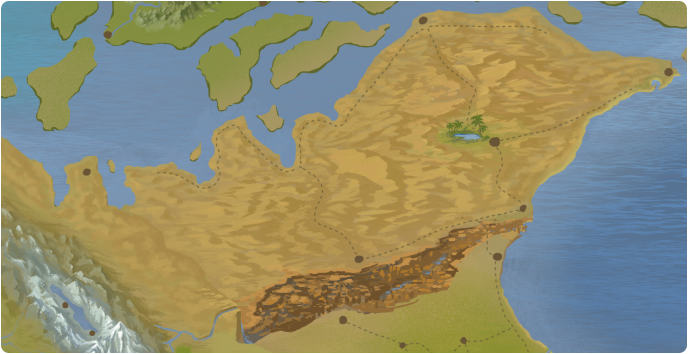
This desert country is found on the northernmost coast of Aimsir, nestled between the sea to the north, the great mountains to the west, and the country of Reithe to the south
In terms of population, Koraha is smaller than the other nations, most of its population settling along the coastal shelf. While most of the population is moderately xenophobic, a significant portion travel among the high societies of the other nations of terra, representing Koraha's interests abroad
Koraha's society is highly structured and has a strong focus on equality, both socially and economically. A common phrase heard on Korahan homes is “We take care of our own”. Generally, this sentiment extends to visiting foreigners, and always to any who travel to and settle in Koraha
Cities
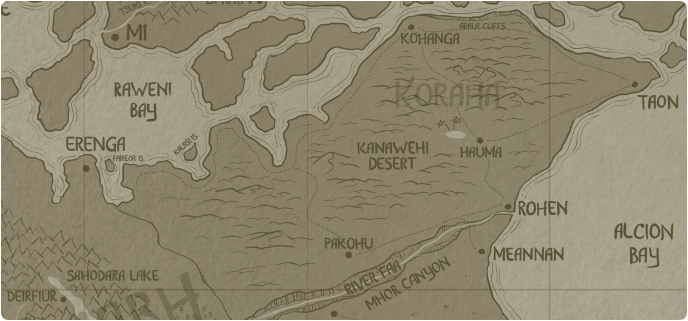
- Erenga - Westernmost city of Koraha, rests on the plateau overlooking the bay, refuge to all
- Hauma - An oasis town watched over by the baumeni in the middle of Koraha's harsh desert dunes
- Kohanga - Capitol city of Koraha, located on the northern fjord coast
- Pakohu - City carved into the northern face of the Great Canyon
- Taon - Peninsular coastal town that guards entry to the Bay of Aimsir
Related geography
- Arala cliffs - Range of cliffs along the northern Koraha coast
- Faireor island - Small island on the south end of Raweni Bay in the Istigh Seas
- Istigh seas - The collective waters among the island archipelago of Aeye
- Kanawehi desert - The desert that covers every corner of Koraha
- Mhor canyon - The largest and longest canyon on terra, on border between Koraha and Reithe
- Raweni bay - Circular bay on the northern coast of Koraha, location of Erenga
- Sliabh mountains - Great mountain range splitting Aimsir into two halves
History
The Korahan coast has a long history of conquest by foreign armies. In the early age of humanoid life on Terra, this region saw the formation of the Kingdom of Dearth'Jhaa. The kingdom thrived, and was the first nation to develop ship building technology. They expanded the range of their ships, eventually landing on the continent of Saoirse and establishing a colony there, the first of its kind. The presence of foreigners united the Ulfar on the planet into a federation known as Akkaus. Akkaus began work on their own ships, and eventually landed on the Korahan coast, conquering the majority of Dearth'Jhaa.
Khan'laheeri would be the next to conquer the area, taking it from the Akkau. Akkaus would reconquer the territory and the refugees would flee to Inis and found the kingdom of Aru'taal. Khan'laheeri and Akkaus would continue to fight over the territory, gaining and losing ground over the years. Eventually Akkaus would completely crush Khan'laheeri and subsequently abandon the territory. In the Age of Balance, Arutal sent colonists to rebuild their homeland, and their efforts were the foundation of present day Koraha
Koraha aided in several reconstruction efforts after their recognition as an independent nation, including the rebuilding efforts on Saoirse and on the Great Arch. As Koraha developed their national identity, they became well known for their military prowess, which played an instrumental role in international peacekeeping. When the need for strong militaries subsided, Koraha exported their expertise as mercenaries, which came to be known as the Mona
Timeline
- 76.0M BCE: The kingdom of Dearth'Jhaa forms in present day Koraha's northern coast
- 56.9M BCE: Akkaus develops shipbuilding
- 50.2M BCE: Akkaus cripples Dearth'Jhaa and occupies the remains of the kingdom
- 44.5M BCE: Khan'laheeri conquers present day Koraha
- 40.9M BCE: Akkaus invades Khan'laheeri on the Korahan Coast
- 39.3M BCE: Akkaus conquers the deserts of present day Koraha
- 20.6M BCE: Khan'laheeri conquers the Korahan Coast
- 6.5M BCE: Khan'laheeri is conquered by the Akkau
- 1.818M BCE: Koraha's nationhood is recognized by Terra's other nations
- 1.483M BCE: Sections of the Great Arch crumble under tectonic stress
- 0.980M BCE: The Mona gain notoriety
- 0.922M BCE: Koraha and Reithe collaborate to restore the Great Arch
- 0.859M BCE: The Great Arch is restored
- 0.623M BCE: Hauma oasis is discovered
Government and laws
Of all the nations of Terra, Koraha is the least changed since the Council of Ceilidh. The nation is lead by the Kaiarahi (KAI-ah-ra-hee), who has far reaching power. In some respects, the Kaiarahi has even more power than the kings of terra's ancient ages. Each territory also has a caliph which serves as a spiritual guide for the people of their city. The territories of Koraha encompass a major city and its surrounding towns
Officially, the Kaiarahi oversees all of the nation's affairs, including the day to day operations of a city. Every citizen is directly ruled by the Kaiarahi. In truth, the caliphs govern the business of a city
Succession in Koraha is determined by the Kaiarahi, for its own position, the caliphs, and the other ministers at the national level. Reforms have added long lists of criteria regarding these appointments, instead of making the appointments elected
Koraha's legal system is extremely subjective, to the point of discouraging foreigners from visiting. Those that do are typically adventurous and almost always have a formal writ of invitation. Visitors that are invited to the country are treated with extreme deference and are exempt from most of the country's laws
Society and culture
Values
Korahans value loyalty and tradition above all else. Loyalty to one's family, caliphate, and Kaiarahi are of utmost importance. Adherence to the tenets of the Tapu govern day to day life. Among these tenets are an importance placed on hospitality, showing respect to elders, seeking enlightenment, and avoiding wastefulness and laziness. In the ancient ages, the Tapu also focused on more militant values, which is seen to be unnecessary in modern times
The devout nature of Koraha's citizens is unique among the nations of terra. Few other nations have official state religions, laws that govern the practice of religion, or laws based on religious tenets. Tapu is seen as a guide to finding the balance in all things, and this concept is seen in every aspect of life in Koraha, including architecture, city planning, art, and even personal appearance
Dress and Appearance
Korahans typically have taller, slender builds, and darker skin. Hair colors are limited to jet black and a silvery white. Eye colors are limited to black, blue, green, and grey. Korahans dress in white linens, dyed a brilliant white, worn loosely on the body. Cuts are typically flowing and are personally designed, a method of expressing creativity and individuality in a society that places less importance on self expression
Adornment is often made of glass, though wood and stone are also used. Piercings and tattoos are common. Symmetry is ubiquitous, and adornment is rarely made asymmetrically, and always done with intention. This applies to clothing and even the styling of the hair. Hair is usually worn long in pony tails or braids. The sides of the head are always shaven, and some shave the top of the head, leaving only a cord of hair from the top or back of the head. The cord of hair symbolizes one's dedication and loyalty to the people and the Tapu. Those that betray the nation or commit grave transgressions against the Tapu will cut their cord at the skull to demonstrate their commitment to rebuilding their honor
Food
Diet in Koraha is fairly simple and does not include alot of variety. Meat is central to a meal, herds of cows, sheep, goats, and chickens are common in the cities and along the coasts. Rice is also a staple, typically accompanied by a coconut based spiced meat stew. Figs, olives, and cherries usually accompany a meal, and more cheeses. Koraha is famous for their rice wine which is infused with vanilla and cinnamon
Music and Arts
Performance art is a part of daily life, traditional dances are integrated into most social gatherings. Dances are accompanied by complex drumming rhythms, other instruments are rare. Sculpture of glass and stone is the predominant art form for expression. Symmetry factors heavily into these designs
Flora and fauna
- Camel - Found across the Kanawehi desert and on the upper plateau
- Cat - Primarily found in and around the cities of Koraha
- Chameleon - Found along the coasts of the desert
- Cougar - Found throughout the nation's cliffs
- Giant Fly - Found throughout the Kanawehi desert, primarily near the coasts
- Hyena - Found throughout the Kanawehi desert
- Pelican - Found in the Arala cliffs and the northern coast of Koraha
- Scorpion - Found throughout the Kanawehi desert
- Striped Buzzard - Found across the desert
- Bluebells - Found along the shores of Alcion bay